Call centres are changing faster than ever. Long queues, repetitive questions, and frustrated agents are being replaced by smart automation, instant answers, and personalised experiences. At the heart of this shift is call centre AI—intelligent technology that listens, understands, and helps both customers and agents in real time. This is why businesses rely on AI for omnichannel support, enabling seamless interactions across channels while boosting efficiency and satisfaction.
When deployed thoughtfully, call centre AI does far more than cut costs. It becomes a growth engine: improving customer satisfaction, unlocking new insights, and empowering teams to deliver consistently high-quality service at scale.
Beyond efficiency, call centre AI is redefining how companies approach technology infrastructure. Organisations are exploring advanced solutions like high-performance computing platforms for enterprise needs to handle complex data and analytics. These platforms allow teams to quickly process large volumes of customer interactions while maintaining accuracy and speed.
At the same time, the rise of cutting-edge supercomputers for AI workloads has made it easier for call centres to deploy intelligent systems without investing heavily in on-premises hardware. By leveraging these resources, businesses can scale AI solutions in real time, providing faster, more personalized support to their customers.
Marketing teams also benefit from insights generated by AI-driven call centre solutions. Platforms like Marketing for Customers offer strategies to understand customer sentiment, track engagement, and align campaigns with real-time feedback from support interactions. This creates a more cohesive customer experience across all touchpoints.
For companies seeking practical implementation strategies, Marketing Runners’ AI integration guides provide step-by-step advice on using AI to optimise both call centre operations and marketing outreach. These guides highlight how AI can improve workflow efficiency, reduce agent burnout, and increase customer satisfaction simultaneously.
Financial planning and resource allocation are also critical for adopting advanced AI technologies. Trusted sources like Top Financial Resources for technology investment help businesses plan budgets, forecast ROI, and evaluate cost-saving opportunities when implementing AI in call centres. Proper financial management ensures that AI initiatives deliver long-term value without straining operational budgets.
By combining AI technology with smart infrastructure and strategic planning, businesses can fully harness the potential of call centre AI. From optimising agent performance to delivering seamless omnichannel experiences, the integration of these tools ensures that companies remain competitive and customer-focused in a rapidly evolving digital landscape.
Top 10 Contact Center Solutions Powered by Call Centre AI
In today’s fast-evolving customer service landscape, call centres are embracing AI to improve efficiency, reduce costs, and deliver better experiences. Here’s a look at the top contact center solutions that leverage call centre AI to transform customer interactions.
1. Bright Pattern – AI Contact Center Solutions
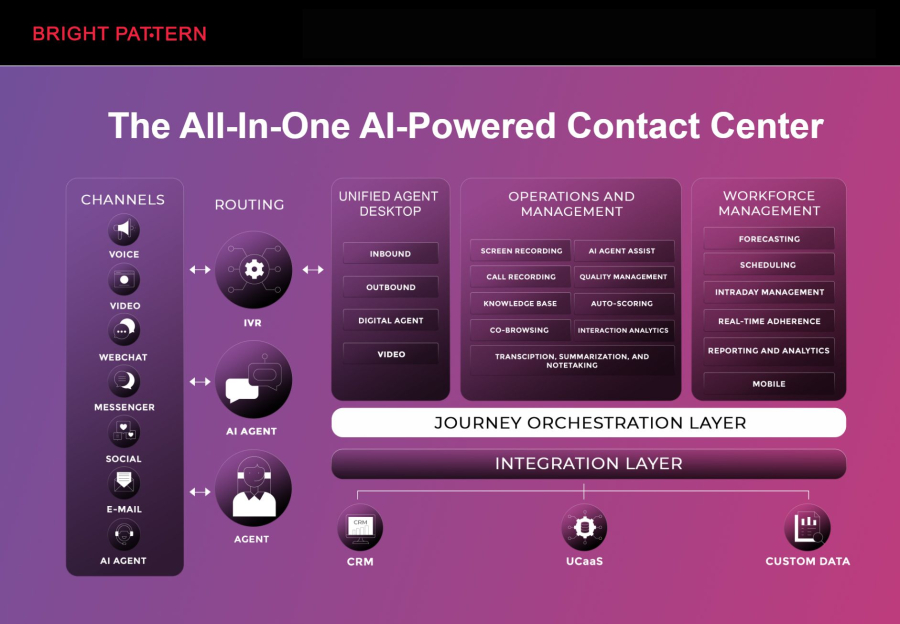
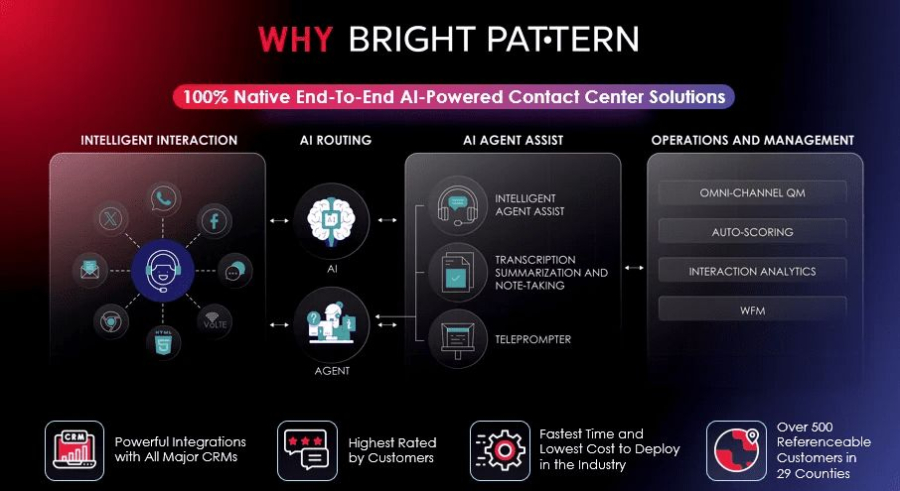
Bright Pattern is a leading provider of AI-driven contact center solutions, helping businesses automate and optimize customer interactions across multiple channels. Their call centre AI platform is designed to deliver seamless omnichannel support, enhance agent productivity, and provide actionable insights.
Key features of Bright Pattern include:
- Intelligent routing of calls, chats, and emails based on real-time context
- AI-assisted agent tools to provide instant suggestions and reduce resolution time
- Predictive analytics for customer behavior and service trends
- Integration with CRM systems to maintain a unified customer view
- Scalable infrastructure to support growing businesses without performance loss
Bright Pattern’s focus on combining AI technology with human-centered design ensures that contact centers can deliver efficient, personalized, and consistent service at scale.
2. Genesys – Cloud Contact Center AI
Genesys offers cloud-based contact center solutions that use AI to predict customer needs and automate routine tasks. Their platform helps businesses improve agent efficiency and customer satisfaction.
3. Five9 – Intelligent Call Center Software
Five9 provides intelligent call center software with AI-powered automation for inbound and outbound customer interactions. It enhances call routing, workforce management, and performance analytics.
4. NICE inContact – AI-Powered Customer Engagement
NICE inContact integrates AI into its customer engagement platform to optimize workflows, automate repetitive tasks, and deliver personalized service experiences.
5. Talkdesk – AI-Driven Cloud Contact Center
Talkdesk uses AI to enhance agent productivity, streamline operations, and analyze customer interactions for continuous improvement. Its machine learning models help predict customer needs.
6. RingCentral Contact Center – Smart AI Tools
RingCentral provides an AI-driven contact center platform with tools for intelligent call routing, speech analytics, and automated support to improve operational efficiency.
7. 8x8 Contact Center – Virtual AI Assistants
8x8 offers virtual AI assistants and analytics to help businesses manage customer interactions more efficiently and deliver faster resolutions.
8. Zendesk – AI Customer Support Solutions
Zendesk combines AI with its customer support software to automate responses, provide knowledge suggestions to agents, and improve response times across channels.
9. Avaya OneCloud – AI Customer Experience Platform
Avaya’s OneCloud solution integrates AI to enhance customer experiences, streamline operations, and provide predictive insights to support decision-making.
10. Cisco Contact Center – AI-Enhanced Support
Cisco Contact Center leverages AI to optimize call routing, improve self-service options, and deliver personalized customer experiences at scale.
What Is Call Centre AI?
Call centre AIrefers to a set of artificial intelligence technologies designed specifically to improve contact centre operations and customer interactions. It is not a single tool, but an ecosystem of capabilities that can work together.
Common components include:
- Virtual agents and chatbotsthat handle routine questions over voice and digital channels.
- Conversational IVR (Interactive Voice Response)that understands natural language instead of relying only on keypad menus.
- Real-time agent assistthat listens to live calls and suggests answers, next steps, or knowledge articles.
- Speech analyticsthat transcribe conversations and uncover trends, sentiment, and root causes.
- Workforce optimisation powered by AIthat forecasts volume, automates scheduling, and predicts staffing needs.
- Quality and compliance monitoringthat automatically evaluates interactions at scale.
These elements can be deployed individually or combined into a unified AI-powered experience across voice, email, chat, and messaging channels.
Why Call Centre AI Matters Now
Customer expectations have shifted dramatically. People want:
- Fast, accurate answers 24 / 7.
- Personalised support that recognises their history and preferences.
- Seamless movement between channels without repeating themselves.
At the same time, many businesses face:
- Rising labour and training costs.
- Fluctuating contact volumes.
- Difficulty maintaining consistent service quality across large teams.
Call centre AI directly addresses this gap. It makes high-quality servicescalable,predictable, andcost effective— even during spikes in demand.
Core Benefits of Call Centre AI
When implemented strategically, call centre AI can deliver measurable gains across the entire customer service operation.
1. Faster Response Times and Shorter Queues
AI systems excel at handling high volumes of simple, repetitive tasks. In a contact centre, that typically means questions like:
- “What is my order status?”
- “How do I reset my password?”
- “What are your opening hours?”
By routing these queries to virtual agents or conversational IVR, customers receive immediate answers without waiting on hold. Human agents are reserved for more complex or sensitive issues.
The result is a direct impact on key metrics:
- Reduced average speed of answer (ASA)because fewer callers wait in queue.
- Lower abandonment ratesas customers get help quickly.
- Improved first contact resolution (FCR)thanks to accurate, consistent answers.
2. Higher Customer Satisfaction and Loyalty
Customers value speed, clarity, and a sense that their issue truly matters. AI contributes to all three:
- 24 / 7 availabilityensures help is always accessible, even outside traditional business hours.
- Personalisationallows AI tools to recognise returning customers, reference their previous interactions, and tailor responses.
- Consistencymeans customers hear the same accurate information regardless of channel or agent.
When customers experience reliable, effortless support, satisfaction and loyalty naturally rise. Over time, this translates into higher lifetime value and stronger brand advocacy.
3. Increased Agent Productivity and Engagement
Call centre work can be demanding and repetitive. AI helps agents focus on engaging, value-adding activities by automating low-value tasks. Examples include:
- Auto-populating account data and case summaries during calls.
- Suggesting relevant knowledge articles or troubleshooting steps in real time.
- Creating call notes and after-call wrap-up summaries automatically.
This shift delivers multiple benefits:
- Higher handle efficiencybecause agents spend more time talking and solving, less time clicking and typing.
- Reduced burnoutas monotonous tasks are minimised.
- Better coaching and developmentsupported by AI-driven feedback and performance insights.
Empowered agents are more likely to stay, grow, and advocate for customers — creating a virtuous cycle of performance.
4. Significant Cost Savings and Operational Efficiency
Well-designed AI deployments often lead to meaningful cost reductions without compromising service quality. Savings come from:
- Self-service deflectionas AI resolves a portion of contacts without human involvement.
- Optimised staffingthrough AI-driven forecasting and scheduling.
- Reduced training timebecause real-time assist tools help newer agents perform like experienced ones.
- Automated quality monitoringthat frees supervisors from manual call reviews.
These efficiencies can be reinvested into higher value initiatives such as proactive outreach, enhanced training, or new customer programs.
5. Deeper Insights from Every Conversation
Every call, chat, or email contains valuable information about customer needs, preferences, and pain points. Historically, most of that insight was locked away in recordings or unstructured notes. AI changes this.
With speech analytics and natural language processing, call centre AI can:
- Transcribe interactions at scale.
- Detect sentiment and emotional cues.
- Spot emerging issues, product defects, or policy confusion.
- Highlight common reasons for contact by segment or region.
Leaders can use these insights to refine products, adjust policies, update FAQs, and prioritise improvements that matter most to customers.
Key Use Cases of Call Centre AI
Call centre AI can be applied across the entire customer journey. The following common use cases show how organisations turn AI into tangible results.
AI-Powered Virtual Agents
Virtual agents use conversational AI to interact with customers in natural language via voice or text. They are ideal for:
- Account balance or order status checks.
- Simple changes such as address updates or subscription modifications.
- Guided troubleshooting for common technical issues.
- Booking, cancelling, or rescheduling appointments.
Modern virtual agents can integrate securely with existing systems to retrieve customer data, perform transactions, and hand off to human agents when needed. This combination of automation and escalation ensures customers always have a clear path to resolution.
Conversational IVR
Traditional IVR menus can be frustrating: long lists of options, confusing paths, and frequent transfers. Conversational IVR replaces rigid menus with natural language understanding. Customers can say what they need in their own words, such as “I want to update my payment method” or “I need to check a recent charge”, and the system routes or resolves accordingly.
The benefits include:
- Shorter call pathswith fewer misroutes.
- Higher containment ratesas the IVR resolves more queries itself.
- Improved caller experiencethanks to a more natural, conversational flow.
Real-Time Agent Assist
Real-time assist tools “listen” to the conversation (with appropriate consent and security) and provide live guidance to the agent. They can:
- Display relevant knowledge articles when key phrases are detected.
- Prompt agents to read required disclosures or follow compliance scripts.
- Suggest next best actions based on historical outcomes.
- Flag at-risk interactions where a supervisor may need to join or support.
This support is especially powerful for new hires, who can deliver confident, accurate help from their first days on the job.
Automated Quality and Compliance Monitoring
In many call centres, only a small fraction of calls are reviewed for quality each month. AI dramatically increases this coverage by automatically evaluating 100 % of interactions for:
- Adherence to scripts and regulatory requirements.
- Use of mandatory disclaimers.
- Customer sentiment and escalation risk.
- Process steps and resolution outcomes.
This continuous monitoring allows leaders to identify training opportunities quickly, recognise high performers, and address issues before they become widespread.
Workforce Management and Forecasting
Accurate forecasting is essential to balancing service levels and costs. AI-powered workforce tools analyse historical patterns, marketing campaigns, seasonal trends, and external factors to predict contact volumes more reliably.
With better forecasts, managers can:
- Schedule the right number of agents for each interval.
- Reduce overtime and understaffed peaks.
- Align skills and channels with expected demand.
This leads to smoother operations and a better experience for both customers and agents.
How Call Centre AI Works: The Technology Layer
Behind the scenes, several core technologies power call centre AI capabilities. Understanding them at a high level helps in evaluating potential solutions.
Natural Language Processing (NLP)
NLPallows AI systems to understand and generate human language. In a call centre, NLP is used to:
- Interpret what customers say or type.
- Identify intents (the goal of the interaction) and key entities (such as names, dates, or product types).
- Generate natural, context-aware responses.
Automatic Speech Recognition (ASR)
ASRconverts spoken language into text in real time. It is a foundation for:
- Voice virtual agents and conversational IVR.
- Live call transcription.
- Post-call analytics and searchability of recordings.
Machine Learning and Predictive Analytics
Machine learning models learn from historical data to make predictions or recommendations. In call centres, they support:
- Routing calls to the best available agent based on skills and likelihood of resolution.
- Predicting customer churn risk during interactions.
- Forecasting call volumes and contact reasons.
- Recommending next best actions or offers.
Knowledge Management and Retrieval
Effective AI needs access to accurate, up-to-date information. Knowledge management systems organise documentation, FAQs, and process guides, while AI-based retrieval finds and presents the right content at the right moment. This underpins both self-service and assisted-service scenarios.
Planning a Successful Call Centre AI Strategy
To unlock the full benefits of call centre AI, a thoughtful approach is essential. The most successful initiatives tend to follow a few clear principles.
1. Start with Business Outcomes
Rather than starting with technology, begin by defining the outcomes you want to achieve. Examples include:
- Reducing average handling time by a specific percentage.
- Improving customer satisfaction scores.
- Increasing self-service containment for simple tasks.
- Lowering agent attrition rates.
Clear goals make it easier to prioritise use cases, measure progress, and secure stakeholder support.
2. Map the Customer Journey
Analyse typical customer journeys and identify moments where AI can remove friction or add value. For example:
- Pre-contact: Proactive notifications or reminders that reduce inbound volume.
- At contact: Virtual agents or conversational IVR to speed resolution.
- Post-contact: Follow-up surveys, sentiment analysis, and proactive outreach based on interaction data.
This ensures AI enhances the overall experience rather than acting as an isolated tool.
3. Involve Agents Early
Agents are essential stakeholders in any AI initiative. Including them from the beginning helps:
- Identify pain points AI can relieve.
- Gather real-world feedback on early prototypes.
- Build trust by showing how AI supports, rather than replaces, their work.
When agents feel that AI is designed to make their jobs easier and more rewarding, adoption and performance both improve.
4. Prioritise Data Quality and Governance
AI performance depends on the quality of underlying data. Strong data practices include:
- Accurate, consistent customer records.
- Clear policies for data access, retention, and privacy.
- Regular audits of AI outputs to ensure fairness and accuracy.
Good governance builds confidence for customers, regulators, and internal teams alike.
5. Start Small, Then Scale
Instead of attempting a full transformation at once, many organisations succeed by launching a focused pilot, such as:
- A virtual agent for a specific, high-volume task.
- Real-time assist in one queue or product line.
- Speech analytics on a subset of recorded calls.
These pilots generate quick wins, provide valuable learning, and build momentum for broader rollout.
Measuring the Impact of Call Centre AI
To demonstrate value and guide optimisation, it is important to track clear metrics before and after AI implementation. Common measures include:
Area | Example Metrics | Typical AI Impact |
Customer Experience | CSAT, NPS, first contact resolution, wait time | Higher satisfaction, faster resolutions, reduced friction |
Operational Efficiency | Average handling time, abandonment rate, self-service rate | Lower handling times, fewer abandoned calls, more automation |
Financial | Cost per contact, overtime, training costs | Reduced cost per interaction and more efficient staffing |
People and Quality | Agent attrition, quality scores, coaching time | Improved quality, better coaching, more engaged agents |
Regularly reviewing these metrics helps fine-tune AI performance and ensures it continues to align with evolving business priorities.
Best Practices for a Human-Centred AI Call Centre
Successful AI in the call centre is not about replacing people; it is about designing a powerful partnership between humans and machines. The following practices support a human-centred approach.
Keep Humans in the Loop
Ensure customers can always reach a human when they need one, especially for sensitive, high-value, or emotionally charged issues. Provide clear options to transfer from self-service or virtual agents to human agents without starting over.
Design for Transparency
Be clear with customers when they are interacting with AI, what data is being used, and how it improves their experience. Transparent communication builds trust and sets realistic expectations.
Continuously Train and Improve
AI models are not static. They perform best when they are continuously trained and updated based on new data, changing policies, and feedback from agents and customers. Establish a regular review and improvement cycle.
Invest in Agent Skills
As AI takes on routine work, agents spend more time on complex, relationship-driven interactions. Support them with training in areas such as:
- Advanced product knowledge.
- Emotional intelligence and de-escalation.
- Consultative and proactive service skills.
This ensures that when customers do reach a human, they receive exceptional, high-value support.
Future Trends in Call Centre AI
Call centre AI continues to evolve rapidly. Organisations that prepare now can stay ahead of the curve and unlock new competitive advantages. Emerging trends include:
- Proactive servicewhere AI predicts issues and reaches out before the customer contacts support.
- Deeper personalisationbased on holistic customer data and preferences.
- Omnichannel orchestrationthat uses AI to coordinate interactions across voice, chat, email, and messaging seamlessly.
- Richer analyticsthat connect contact centre data with marketing, sales, and product teams for enterprise-wide insight.
These capabilities point toward a future where the contact centre is not just a cost centre, but a strategic hub for customer understanding and growth.
Conclusion: Turning Call Centre AI into a Competitive Advantage
Call centre AI is transforming how organisations connect with their customers. By combining intelligent automation, real-time insights, and human empathy, businesses can deliver faster, more personalised, and more consistent support than ever before.
When approached thoughtfully, AI in the contact centre unlocks a powerful set of benefits: higher satisfaction, lower costs, more engaged agents, and richer insight into what customers truly need. Companies that embrace this technology with a clear strategy and a human-centred mindset are well positioned to turn their call centres into lasting competitive advantages.
The opportunity is clear: use call centre AI not just to answer calls more efficiently, but to build deeper, more rewarding relationships with every customer you serve.
